What Should You Monitor in Your Baby?
Modern baby wellness monitoring covers six critical signals. Each one tells you something different about your baby's health and comfort.
Breathing Rate
The most critical safety signal. Irregular breathing or long pauses can indicate respiratory issues. Anvaya tracks this contactlessly 24/7.
SpO2 (Blood Oxygen)
Blood oxygen saturation shows how effectively your baby is breathing. Traditionally required a wearable clip — Anvaya SENSE monitors it contactlessly.
Cry Analysis
Different cries have distinct acoustic patterns. AI analysis tells you what your baby needs before you have to guess — especially valuable at 2am.
Body Temperature
Fever in a newborn (over 38°C) requires immediate attention. Hypothermia (below 36°C) is equally dangerous. Continuous tracking catches changes before they escalate.
Sleep Cycles
Understanding your baby's sleep architecture helps you predict wake times, optimise nap schedules, and identify sleep regression patterns early.
Room Air Quality
Air quality directly affects infant breathing and sleep. High CO2 or dry air disrupts sleep quality and can cause respiratory irritation.
How Does Contactless Baby Monitoring Work?
Radar Sensing
Ultra-low-power radar waves detect the tiny chest movements caused by breathing. Accurate to within 0.1mm of movement — sensitive enough to detect a newborn's breath from 90cm away.
Infrared Thermal
Passive infrared sensors read surface body temperature without contact or light. Works in complete darkness. Detects fever before a traditional thermometer would.
AI Acoustic Analysis
Machine learning models trained on thousands of infant cry recordings identify cry type, intensity, and urgency in real time. Personalized to your baby's unique cry signature after 3 days of learning.
"Contactless monitoring is the future of infant safety. The ability to track breathing and SpO2 without attaching anything to a newborn's skin represents a significant advancement in peace-of-mind for parents."
How to Set Up Baby Monitoring at Home
Setting up Anvaya Smart takes under 3 minutes. Here's the step-by-step process:
Place Anvaya Smart on a surface 60–90cm from the crib
Position the pod on a nightstand or shelf at baby's chest height. This is the optimal sensing distance for all 6 monitoring signals.
Plug in via USB-C and wait 30 seconds
The pod initialises its baseline sensors and connects to your home WiFi. The status indicator turns solid green when ready.
Download the Anvaya Smart app and create your baby's profile
Enter your baby's name, age and any relevant health notes. This helps the AI personalise alerts to your baby's specific patterns.
Run the 5-minute baseline calibration
Place baby in the crib and tap "Start Calibration." Anvaya learns your baby's unique breathing rhythm, cry signature and baseline temperature.
Review your first night's report in the morning
The app shows sleep stages, breathing chart, temperature log, and any cry events. Your first report establishes the baseline for all future AI insights.
Anvaya Smart — Built for Indian Parents
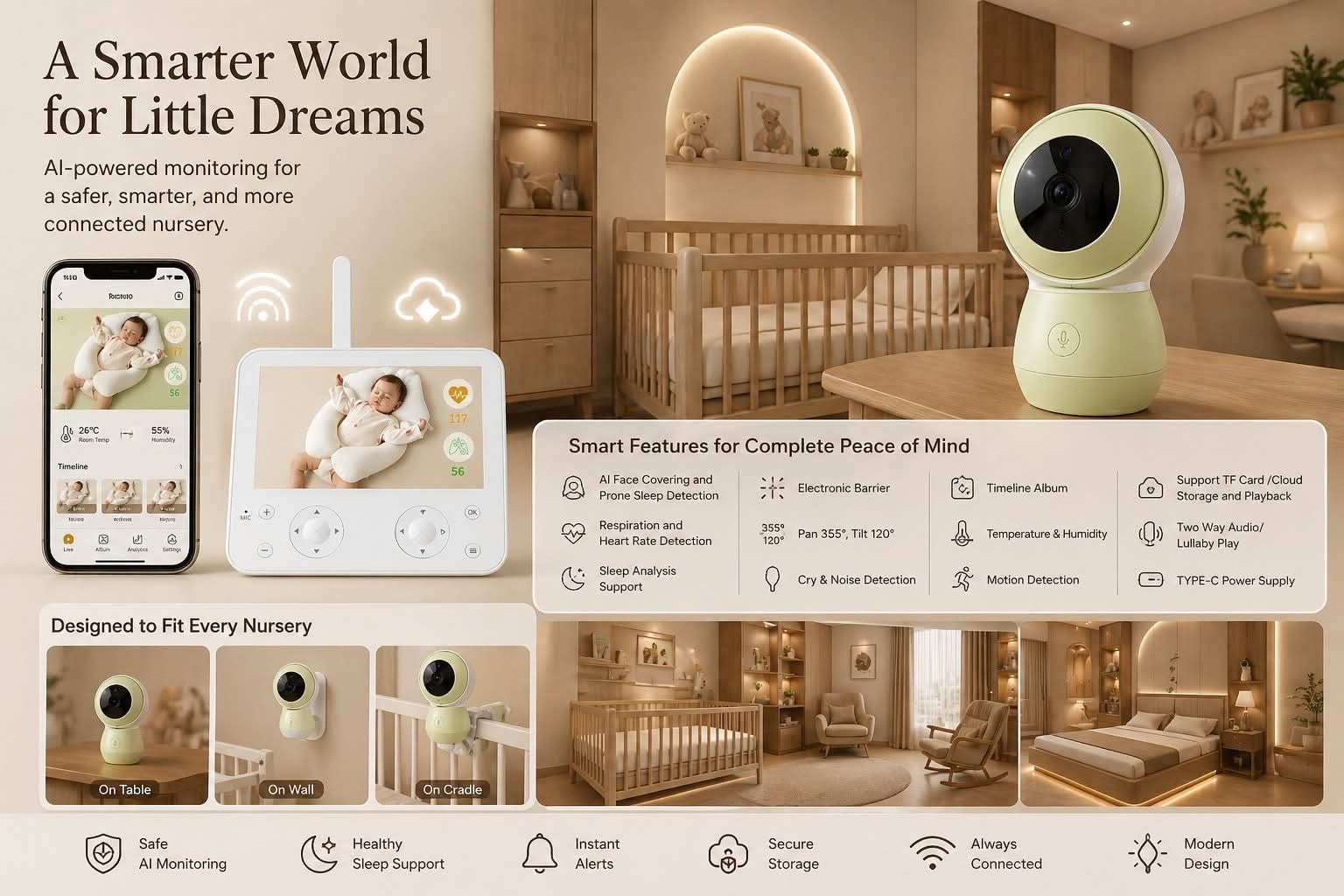
India's only contactless AI baby monitor. Four models designed for every budget and stage of parenting.
Frequently Asked Questions
What is baby monitoring?
Baby monitoring refers to using technology to continuously track an infant's vital signs, movements, cries and environment — typically breathing rate, SpO2 (blood oxygen), heart rate, body temperature, cry patterns and sleep quality. Modern AI baby monitors like Anvaya Smart do this contactlessly, without attaching anything to the baby.
What should a baby monitor track in India?
For Indian parents, the most important metrics are: breathing patterns (detects irregularities during sleep), SpO2 or blood oxygen saturation (should stay above 95%), cry analysis (hungry vs tired vs uncomfortable), room temperature (ideal 20–22°C), air quality, and sleep cycle tracking. Anvaya SENSE covers all of these contactlessly.
Is baby monitoring safe for newborns?
Contactless baby monitors like Anvaya Smart are completely safe. They use passive radar and infrared sensing — no radiation, no harmful signals, no bright lights. The American Academy of Pediatrics (AAP) recommends monitoring infant breathing during sleep.
What is the difference between a baby monitor and a baby wellness monitor?
A basic baby monitor shows video and audio. A baby wellness monitor like Anvaya Smart additionally tracks physiological signals — breathing, SpO2, heart rate, temperature — and uses AI to understand patterns. It alerts you only when something genuinely needs attention, not for every movement.
What is a normal breathing rate for a baby?
Newborns breathe at 40–60 breaths per minute. Infants 6–12 months typically breathe at 25–40 breaths per minute. Brief pauses of 5–10 seconds are normal (periodic breathing) — Anvaya Smart distinguishes these from genuinely concerning pauses.
How does contactless baby monitoring work?
Anvaya Smart uses a combination of low-power radar (detects micro-movements from breathing), infrared thermal imaging (tracks body temperature passively), and AI acoustic analysis (processes cry sounds). All processing happens on the device — nothing is sent to the cloud.
- [1]American Academy of Pediatrics: Recommends monitoring infant breathing patterns during sleep
- [2]WHO Infant Care Guidelines: Thermal comfort and environment monitoring for newborns
- [3]BITS Hyderabad Research Lab: Radar-based contactless vital sensing for infants