How Much Should a Baby Sleep? Month-by-Month Guide for India
Baby sleep needs change dramatically in the first year — and the gap between what parents expect and what babies actually do is one of the biggest sources of new-parent anxiety in India. Here is a realistic month-by-month picture:
| Age | Total Daily Sleep | Night Sleep | Naps | Longest stretch |
|---|---|---|---|---|
| 0–1 month | 16–18 hours | 8–9 hours (fragmented) | 6–7 naps | 2–3 hours |
| 1–3 months | 14–17 hours | 9–10 hours | 4–5 naps | 3–4 hours |
| 3–6 months | 13–15 hours | 10–11 hours | 3–4 naps | 4–6 hours |
| 6–9 months | 12–14 hours | 11 hours | 2–3 naps | 5–8 hours |
| 9–12 months | 12–14 hours | 11 hours | 2 naps | 6–10 hours |
The most important thing to know: "Sleeping through the night" for a baby means a 5–6 hour stretch, not 8 hours. Most babies do not sleep 8 unbroken hours until well past 6 months — and many do not until after their first birthday. This is biologically normal, not a parenting failure.
Why Babies Wake Up So Often — The Science of Baby Sleep Cycles
Adults have 90-minute sleep cycles. Babies cycle through sleep stages every 45–50 minutes. At the end of each cycle, they briefly surface toward wakefulness — and many will fully wake if their sleep environment has changed (you've moved them, the sound has stopped, the room is now dark when it was light). This is called "sleep cycle bridging" and is the core reason babies need help falling back asleep between cycles.
As babies develop, they gradually learn to bridge cycles on their own — this is what "sleeping through the night" actually is. It is a developmental skill, not something that can be forced before the baby's brain is ready.
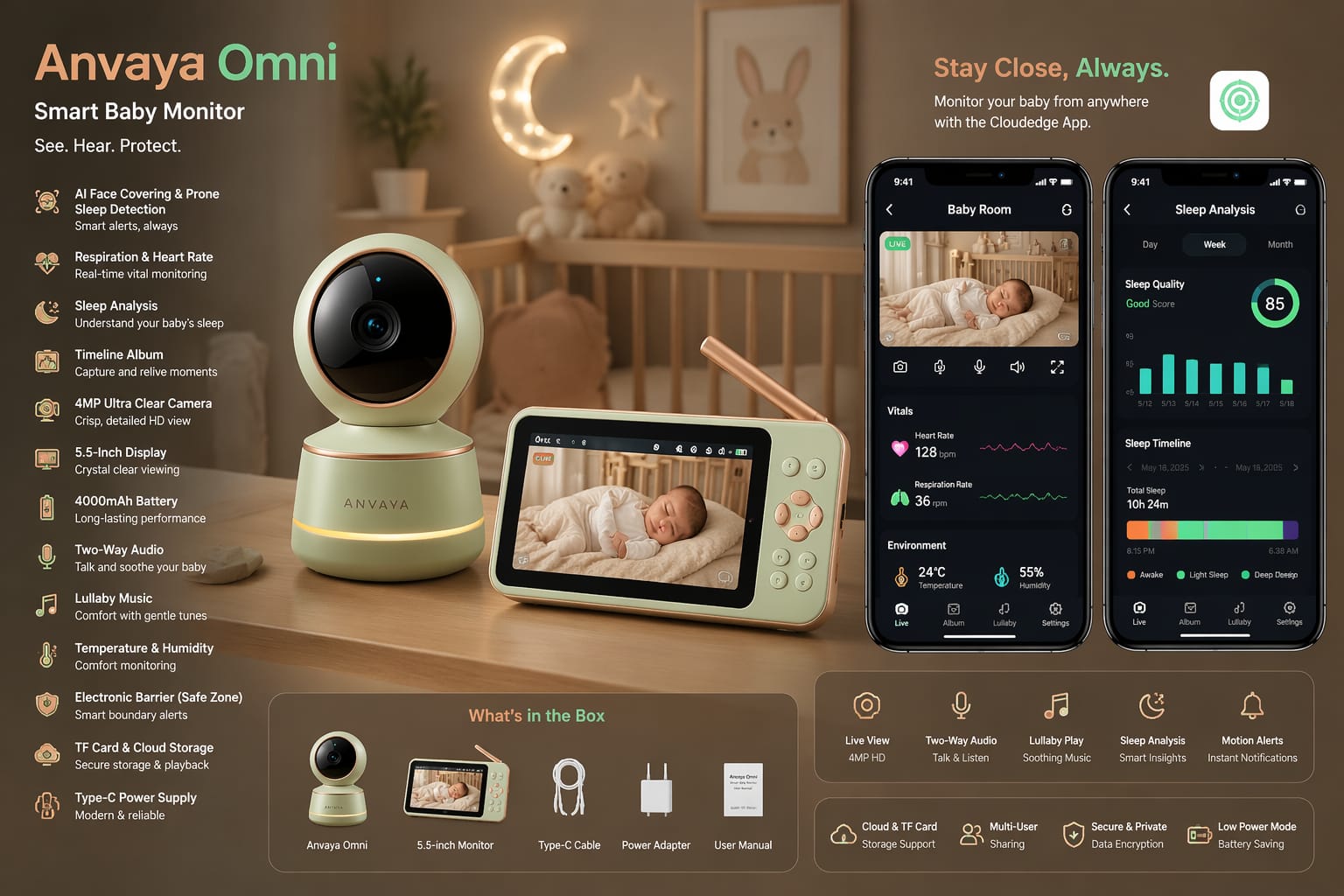
Anvaya Smart's sleep analysis identifies which sleep stage your baby is in — light sleep, deep sleep, or awake — and tracks how many complete cycles they achieve each night. This gives you actionable data: "3 complete cycles, 2 partial cycles" is more useful than "7 hours total."
The 4-Month Sleep Regression — The Hardest One
The 4-month regression is the most significant sleep regression your baby will go through — and it is the one that surprises Indian parents the most, because many babies who were sleeping reasonably well suddenly start waking every 45–60 minutes. This is not a coincidence. At 4 months, the brain undergoes a structural shift in how it organises sleep: the sleep architecture permanently changes to become more like adult sleep, with distinct NREM and REM cycles. This is a one-way change — the 4-month regression does not end; it is simply the new normal that babies then need to learn to navigate.
Signs of the 4-month regression:
- Suddenly waking every 45–60 minutes at night (matching sleep cycle length)
- Refusing to be put down without waking
- Naps become very short (30–45 minutes exactly — one sleep cycle)
- Increased fussiness and feeding more frequently
How to get through it: The only real solution is helping your baby learn to put themselves back to sleep at the end of each cycle. This means being consistent with your response (whatever approach you choose), using a consistent sleep environment (same room, same sounds, same darkness), and giving it time. Most 4-month regressions improve within 2–6 weeks.
Co-Sleeping in India — Safety Guidelines
Co-sleeping is deeply embedded in Indian family culture and has genuine benefits: easier night nursing, stronger bonding, and for many families, it is simply how space is managed in the home. The challenge is that most co-sleeping safety research is based on Western bedding and sleeping arrangements. Here is how to co-sleep as safely as possible in the Indian context:
- Firm mattress, no soft bedding: Traditional Indian mattresses on the floor are actually safer than elevated beds with pillow-top mattresses. Ensure no heavy blankets, pillows, or bolsters near the baby.
- No co-sleeping if either parent has consumed alcohol, sedatives, or is heavily medicated.
- Sidecar arrangement: A baby cot positioned with one side down against the adult bed is the safest co-sleeping compromise — close enough for night feeds, with the baby on their own firm surface.
- No smoking parents: A smoking parent co-sleeping with a baby significantly elevates SIDS risk regardless of bedding type.
- Never leave baby alone on adult bed: Adult beds are designed for adults, not babies. A baby left alone on an adult mattress can roll into gaps or suffocate on soft bedding.
Sleep Environment for Indian Conditions
Setting up the right sleep environment in India requires accounting for factors that international sleep guides ignore:
Temperature and AC Use
The target sleep temperature is 20–22°C. In most Indian cities, this requires AC for much of the year. Tips for AC and baby sleep:
- Do not point AC directly at the baby — use a fan to circulate air instead
- Set AC to 24–26°C if the room drops below 20°C at the target setting
- Use a room thermometer (Anvaya Smart includes one) to confirm actual room temperature, not just AC setting
- Dress the baby appropriately for AC — a thin cotton onesie plus one layer (muslin swaddle or sleep sack) is usually sufficient
Noise Management
Indian homes are rarely quiet — traffic, construction, relatives, temple bells. White noise (consistent shushing or fan sound) at around 50–60 dB masks these intermittent sounds and extends sleep duration. Many Indian parents find this counterintuitive, but the science is consistent: continuous moderate noise beats silence in an unpredictably noisy environment.
Light Control
Darkness triggers melatonin release. Even in the day, naptime darkness helps babies fall asleep and stay asleep. Heavy curtains or a temporary blackout blind (even a cardboard sheet covering the window) makes a measurable difference to nap quality.
Sleep Regressions: The Full Timeline
| Age | Regression | Cause | Duration |
|---|---|---|---|
| 4 months | Major — most disruptive | Permanent change in sleep architecture | 2–6 weeks (permanent adjustment) |
| 8–10 months | Moderate | Crawling, standing, separation anxiety development | 2–4 weeks |
| 12 months | Mild–Moderate | Walking development, nap transition (2 → 1 nap) | 2–3 weeks |
Building Healthy Sleep Habits from Birth
Whatever your family's co-sleeping or room-sharing arrangement, these principles help build good sleep associations that last:
- Consistent bedtime routine: Bath → feed → lullaby → sleep (same sequence, same time each night). Babies' cortisol rhythms respond to routine consistency within 2–3 weeks of starting.
- Drowsy but awake: Put baby down when sleepy but not fully asleep. This is the single most important skill — it teaches the baby that the crib is where sleep happens, not your arms.
- Dark room: Even during daytime naps — darkness signals sleep hormone (melatonin) release.
- White noise: Especially effective in noisy Indian homes. A consistent shush or fan noise at 50–60 dB masks intermittent sounds that cause micro-arousals.
- Temperature: 20–22°C is optimal — Anvaya Smart monitors this automatically and alerts you if the room becomes too warm or too cold overnight.
- Consistent response: Whatever approach you use at night — pick up, pat, shush — do the same thing every time. Inconsistency is harder for babies to adapt to than any particular method.
During sleep, monitoring your baby's breathing and SpO2 levels is especially important. A contactless breathing monitor watches over your baby through every sleep cycle without disturbing them. See our best baby monitor India guide to choose the right device for your family.
Monitor your baby with Anvaya Smart
India's only contactless AI baby monitor. Breathing, SpO2, cry analysis, sleep tracking. Starting ₹8,999.
Get Early Access — Save ₹7,000About the Author
A team of engineers and parents who built Anvaya Smart after experiencing first-hand the anxiety of monitoring a newborn. 7+ years in AI sensing systems. IIT research partnerships.


