Why Indian Parents Are Moving Away from Wearable Baby Monitors
Wearable baby monitors — socks, ankle bands, clip-on pulse oximeters — were designed for Western climates. In India's heat and humidity, they cause problems that most product reviews don't mention:
- Rashes and irritation: Fabric sensors trap sweat against newborn skin, causing contact dermatitis — especially in summers above 35°C
- Falling off during sleep: Babies move. Socks and clips detach, triggering false alarms at 2am or — worse — silently stopping monitoring without alerting parents
- Sleep disturbance: The sensation of a clip or band on a tiny foot often disrupts sleep cycles, defeating the purpose of monitoring
- Import costs: Most wearable infant monitors are not officially available in India, costing ₹35,000–₹45,000 with import duties and no local warranty
Contactless breathing monitors solve all four problems by monitoring from beside the crib — nothing touches your baby's skin.
How Does a Baby Breathing Monitor Without Wearable Work?
There are two main technologies used in contactless baby breathing monitors:
1. Radar-Based Breathing Detection
Low-power radar (the same technology used in automotive collision-avoidance systems) emits a signal that bounces off your baby's body. The reflected signal contains micro-Doppler information — tiny movements caused by the chest rising and falling with each breath.
The AI processes these micro-movements to calculate breathing rate, identify the breathing pattern, and detect pauses. Anvaya Smart uses this technology to monitor breathing from up to 90cm away with no contact required.
Accuracy: Radar-based contactless monitoring has been validated to within ±1 breath/minute of medical-grade wearable monitors in clinical studies.
2. Camera-Based Breathing Detection
Some monitors use high-resolution cameras with motion amplification algorithms to detect the subtle visual movement of breathing. This works well in good lighting but can be affected by blankets, clothing, and low-light conditions.
Radar sensing is generally more reliable because it works through clothing and blankets, is unaffected by lighting, and can operate in complete darkness.
Normal Baby Breathing Rates — What the Monitor Should Track
| Age | Normal Rate | Alert Threshold |
|---|---|---|
| Newborn (0–4 weeks) | 40–60 breaths/min | Above 60 or below 30 |
| 1–3 months | 35–55 breaths/min | Above 55 or below 25 |
| 3–6 months | 30–45 breaths/min | Above 50 or below 20 |
| 6–12 months | 25–40 breaths/min | Above 45 or below 20 |
A good contactless breathing monitor does not just alert when the rate crosses a threshold — it learns your baby's personal baseline and alerts when the pattern meaningfully deviates from what is normal for your specific baby.
Contactless vs Wearable Baby Breathing Monitors — Full Comparison
| Feature | Contactless (Radar) | Wearable (Sock/Clip) |
|---|---|---|
| Comfort in Indian heat | ✓ Nothing on baby | ✗ Sweating, rashes |
| Stays in place during sleep | ✓ Fixed beside crib | ✗ Falls off frequently |
| Works through clothing/blankets | ✓ Radar penetrates | ✓ Direct contact |
| India availability | ✓ Anvaya from ₹12,999 | ✗ Import only, ₹35,000+ |
| India warranty | ✓ 1-year full warranty | ✗ No India support |
| Privacy | ✓ On-device processing | ✗ Cloud-dependent |
| Disturbs baby sleep | ✓ Zero disturbance | ✗ Sensation disrupts sleep |
Who Needs a Baby Breathing Monitor Most?
While all parents benefit from breathing monitoring in the first 6 months, it is especially important for:
- Premature babies — born before 37 weeks, at higher risk of apnea of prematurity
- Babies with history of breathing issues — NICU stays, respiratory distress at birth
- Siblings of SIDS cases — elevated risk in subsequent children
- Babies recovering from respiratory illness — RSV, bronchiolitis, pneumonia
- First-time parents — breathing monitoring provides confidence and reduces anxiety significantly
Setting Up a Contactless Baby Breathing Monitor in India
For optimal monitoring, position the device:
- Distance: 60–90cm from your baby — beside or at the head of the crib
- Height: At the same level as your baby's chest or slightly above
- Angle: Pointed directly at the baby's chest area
- Avoid: Placing between the baby and a wall fan or AC unit — airflow can interfere with radar sensing
Anvaya Smart — India's Best Contactless Baby Breathing Monitor
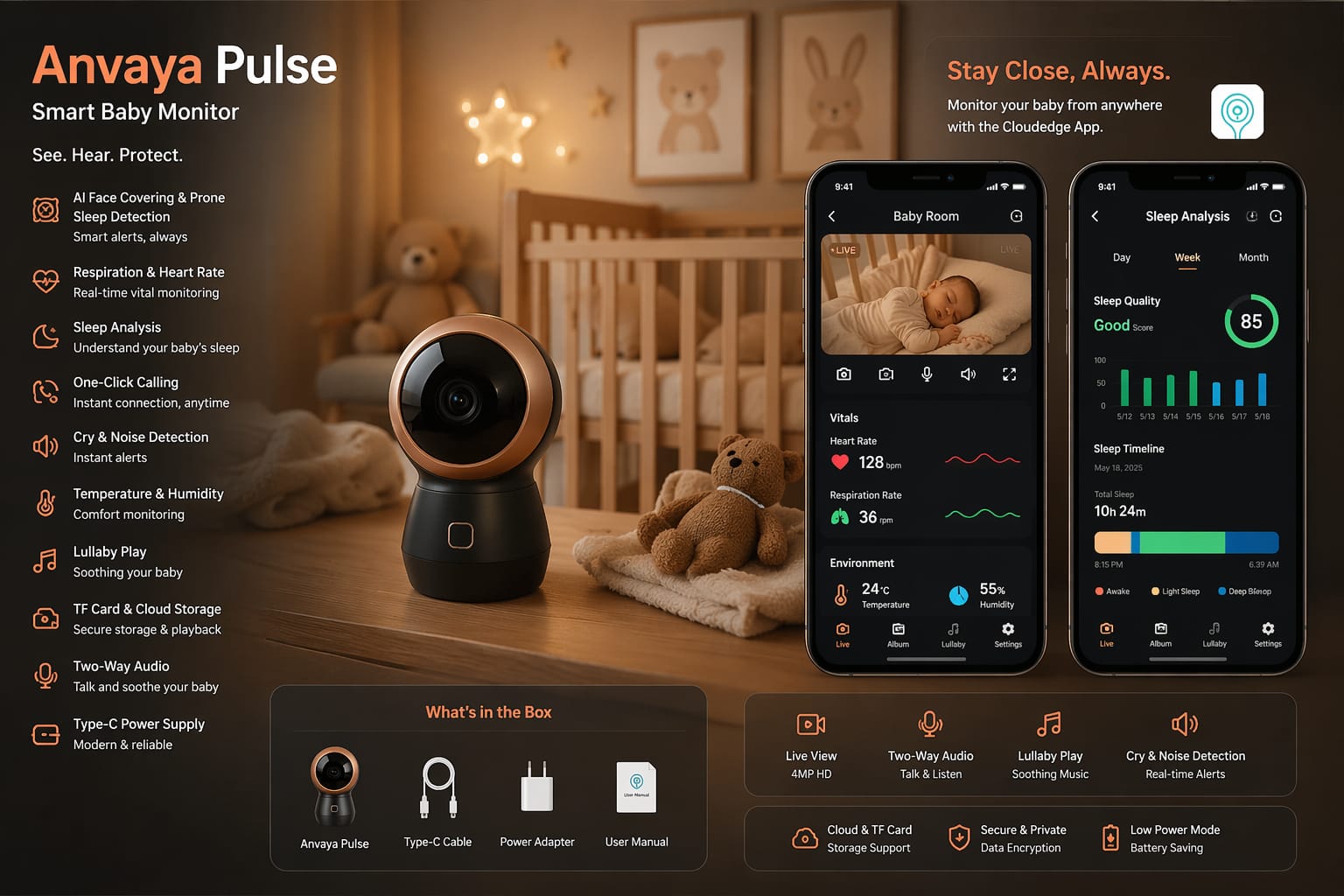
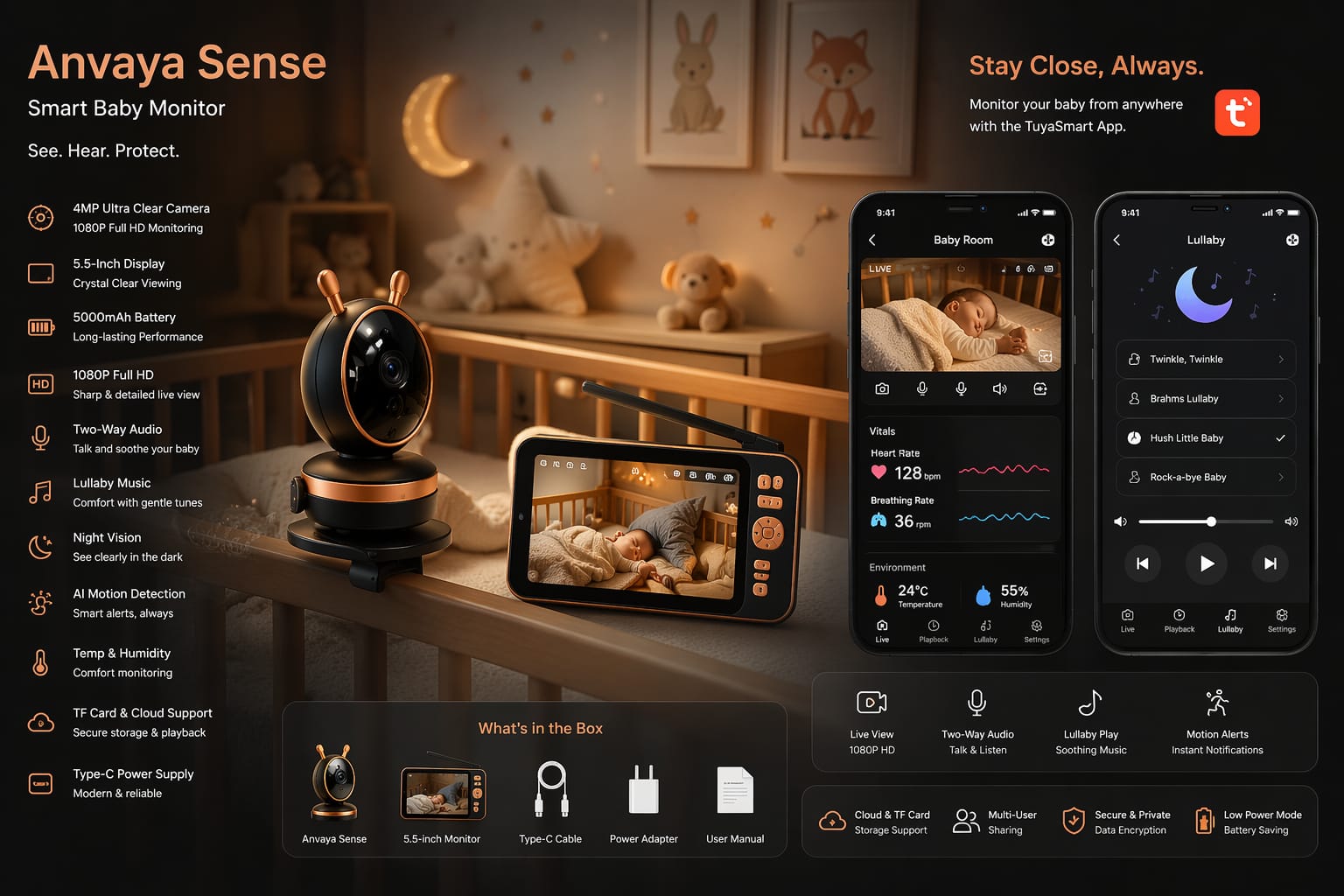
Anvaya Smart SENSE (₹12,999) is the only contactless baby breathing monitor designed and warranted for India. It combines radar-based breathing monitoring with SpO₂ detection, AI cry analysis, and sleep tracking — all without anything touching your baby.
- Breathing rate monitoring: contactless, continuous, ±1 breath/min accuracy
- Apnea alert: configurable pause threshold (default 15 seconds)
- SpO₂ monitoring: contactless blood oxygen tracking
- On-device AI: no cloud, complete privacy
- India warranty: 1 year full warranty + free shipping + 0% EMI
How does a contactless baby breathing monitor work in India's heat?
Radar-based breathing monitors are completely unaffected by temperature or humidity. They work equally well in a 20°C air-conditioned nursery and a 35°C room during a power cut. This makes them significantly more reliable in Indian conditions than wearable sensors, which can lose contact due to sweat.
Can a contactless monitor detect SIDS risk?
No monitor can predict or prevent SIDS. However, a contactless breathing monitor can alert parents to prolonged breathing pauses (apnea), low oxygen levels, or abnormal breathing patterns — allowing faster response to respiratory emergencies. Following safe sleep guidelines (back to sleep, firm mattress, smoke-free home) remains the most effective SIDS prevention.
Is radar safe for newborns?
Yes. The radar sensing used in Anvaya Smart operates at power levels measured in microwatts — thousands of times lower than a Wi-Fi router, and far below any established safety threshold for infants. It has been tested to international EMF safety standards.
For a full picture of what to monitor and why, read our guides on normal baby breathing patterns, baby SpO2 monitoring, and how AI baby monitors work. Ready to buy? See the best baby monitor India 2026 comparison.
Monitor your baby with Anvaya Smart
India's only contactless AI baby monitor. Breathing, SpO2, cry analysis, sleep tracking. Starting ₹8,999.
Get Early Access — Save ₹7,000About the Author
A team of engineers and parents who built Anvaya Smart after experiencing first-hand the anxiety of monitoring a newborn. 7+ years in AI sensing systems. IIT research partnerships.